So now that the course is about to end I wonder what have I learnt? Well I know it pays to be early to Mr. McDaniel's class as you get lots of free snacks. But seriously has the course been beneficial?
I must answer this with a resounding yes. I think that this course is timely as the UWI pushes to create more distinctive graduates. With the state of Caribbean economies and more students graduating and looking for jobs, it is time that we help mold job creators rather than job seekers.
I was impressed by Uncle Gerry's (yes we call him Uncle Gerry in class sometimes) network and how it has proved useful for us in class. From David Mullings whom I followed on Twitter since my 1st year at UWI to Skyping with Alison Hinds to trips to the Jamaica Stock Exchange and the Bob Marley Museum, this network has afforded the students of this course a great opportunity to not only learn but to grow their own network.
I am also pleased with the model of the course. It is not restrictive as we were allowed to tweet in class, take pictures and of course blog. This should equip us with some good multi-tasking as well as social media use skills that we can take out in to the working world. Imagine being asked by a company to cover an event via Twitter for their customers This should be easy now as we have done it in class.
I think the most important lesson though was taking an idea and making it into a reality. We have been given articles, tips from real life entrepreneurs and have even pitched ideas to potential investors. All we need now is the courage to go do it in the real world. Now I know we may be afraid but what the reward with out the risk. So here's to becoming an entrepreneur!
Showing posts with label UWI. Show all posts
Showing posts with label UWI. Show all posts
Friday, April 26, 2013

Thursday, April 4, 2013
THE CARIBBEAN’S RENNAISANCE WOMAN IN COMMUNICATION
In a communications
industry dominated by men, it is a rarity to find a woman who has produced a
highly successful entertainment show. It is even rarer that the woman is the
Chief Executive Officer of her own entertainment media company. Yet if we are
to use these two things to judge Lisa Wickham, it is only the tip of the
iceberg. This successful entrepreneur has been making strides in the
communications industry in Trinidad and Tobago as well as the regional and
international markets. Her name is synonymous with entertainment reporting
throughout the Caribbean and as of 2013 with film. But who is this woman and
why is she making waves in the industry?

Lisa
Wickham is a household name in Trinidad. Her work spans decades which is why
she is loved by both young and old. Wickham started at the tender age of six in
television on the weekly children’s TV show Rikki Tikki. This was to open up
the industry to her and lead her down a road of success to the woman she is
today. She would go on to star in her own segment on the same show. With her
star on the rise Wickham was selected to host ‘Party Time’, a weekly Teen
talent show. While enjoying this success Wickham stayed focus seeing education
as a compliment to her roles on television. She successfully graduated Holy Name
Convent and then went on to study at The University of the West Indies St.
Augustine campus. Her ambition to be successful in both areas saw her receiving
numerous hosting gigs while she continued her studies. She would graduate with
a Bachelors of Science degree in Management with First Class Honours. This same
ambition she applies to all her pursuits and would take her into the industry
even further.
On
completion of her degree Wickham applied for several jobs. In an interview with
Caribbean Belle magazine, she recalled how she would turn negatives to a
positive. “Many years ago,” she recalls, “I had a job interview where the
interviewer condescendingly asked how I planned to reconcile my Party Time
image with a serious career in HR Management.” This would discourage her for a
while and her question herself. Yet it would be one of her mentors who
recognized her talent would make her adapt and excel. “One of my mentors at The
University of the West Indies, Dr. Gwendoline Williams, who noticed my despondency,
advised me to merge an academic/corporate career with a creative one. I had to
find something that allowed me to excel at both.”

Lisa (left) with Sir Richard Branson and co -host of E-Zone Jason Williams
Wickham
ensured that in her career she created a network of persons who could mentor
her in the communications industry. Her network of mentors and benefactors
included Russell Winston, Barbara Assoon, Allyson Hennessy, Merlin Hernandez,
Dominic Kalipersad, Eddison Carr, Linus Pitt, Curtis Drayton, Benedict Joseph
and Hazel Ward. With such an extensive array of contacts, she was able to learn
more about the communications industry and begin charting a way for her.
With a vision of
what she wanted and not averse to taking a risk, Wickham founded her company in
1999. She maintains that it wasn’t an easy undertaking but she was not
expecting it to be. She continued working in television hosting several shows
including morning shows on Trinidad & Tobago Television (TTT) as well as
guest appearances on Mornin’ Barbados, the prime time television show on the Caribbean Broadcasting Corporation between
2002 and 2005. During this time she would co –produced and this would begin her
strategic move from just hosting to producing and eventually content creation
and directing.
With her skills sharpened, Wickham launched
E-Zone television show which she produced, directed and co hosted. The show
which focused on entertainment throughout the Caribbean became a syndicated
show in over 20 Caribbean countries. The show was picked up in both the US and
Canadian television markets and aired on Omni and BET J. The show is unique in
its scope as it is one of the only shows that look at entertainment from both a
Caribbean and Diaspora perspective. Lisa has produced E-Zone shows on Caribbean
carnivals as well as the largest Diaspora festivals including Caribana and
Notting Hill Carnival.
As extensive as
her professional resume is Wickham has an academic resume and work record to rival
it. In addition to her degree from The University of the West Indies, Wickham
graduated from Warwick Business School in the UK with a Masters in Business
Administration with Distinction. She
also attended Wirschaftuniversität, Vienna, Austria, Indian Institute of
Management, Ahmedabad, India, University of Oxford, Said Business School,
Executive Development and the London Film Academy. Wickham’s experience
encompasses from where she served as General Manager of the University of the
West Indies, Institute of Business (IOB) to being Head of the Global Quality
Exchange, a World Bank Project for Business Expansion and Industrial
Restructuring for Trinidad & Tobago. With such qualifications Wickham is
not only accomplished academically but has also written for several newspapers
as well as business journals. Her qualifications have given her the advantage
of combining her creativity with her business background to ensure a formula
for success.
Wickham admits
that her first foray into the world of production was not easy. “Some of the
projects I’ve had to produce required me to read and internalize a sixty-eight
page budget speech in one day, and produce an exciting four-minute vignette
that both encapsulated the speech and captivated the interest of the average
viewer.” Yet this did not deter her in her work and served to make her more
determined.
With her
qualification in film and her past experience, Wickham was curious about the
film industry in the Caribbean as well as in the Diaspora community. While she
had produced for local and regional TV as well as several music videos, she was
entering a new realm. She started producing and directing films. Among those that were critically acclaimed,
she produced and directed a 50-minute documentary that looks at the economic
contribution of the multi-cultured members of the Caribbean Diaspora to their
countries of origin. “It was based on research conducted by Dr. Keith Nurse and
his team at the Shridath Ramphal Centre, UWI Cave Hill, Barbados. I was the
producer-director and in one month I had to set up the filming of locations and
interviews across several languages.” This has opened several doors for her
including her latest film endeavour as line producer to the big budget film
“Home Again” which was filmed in Trinidad and opened in North America. It
continues to receive critical acclaim and has tackled the sensitive issue of
deportees and their readjustments into their birth country, of which many do
not know the culture and customs.
Wickham however
is not restricted in the use of her talents to television and film. In 2007 and
2008, she was the Artistic Director and Producer (for both stage and
television) of the highly acclaimed Annual COTT Music Awards, including the
COTT Foundation Awards Dinner. She has also been a contributor to BBC Radio 5
Live and BBC 1 XTRA showing her versatility.
And in all of
this Wickham has found the time to grow her company to become one of the
largest media companies in Trinidad. Imagine Media is the company of which
Wickham is the Chief Executive Officer. She has taken the E zone brand and
grown it to become E Zone Magazine, E Zone events, E Zone Entertainment and the
Caribbean Film and Media Academy. The company’s mission is based on the
attributes of integrity, innovation and value for money, some of the same
ideals that Wickham herself live by.

And she has not
forgotten where she is from and ways to help. In addition to mentoring several
up and coming filmmakers, Wickham continues serving in the community. She sits
on several boards including the UWI Development & Endowment Fund as well as
served in several NGOs including as President of the Upper Belmont Lions Club
and as a Board Member of United Way Trinidad and Tobago
So
what is the future for Lisa Wickham? She looks forward to continue innovating
in her company and in the industry. She expressed her hope to develop the
necessary training and acquire more equipment to help the Caribbean film
industry contend with our Northern neighbours and especially Hollywood. She
stresses however that there has to be an effort by most of the stakeholders to
make such a dream a reality and she hopes that this will come about since
Caribbean writers have so much to offer.
As a mother she is inspired by nature and revels in her alone time.
“Silence, in a space filled with natural energy, sends my mind crazy with
ideas.” she noted in an interview.
With
entrepreneurs like Lisa Wickham to work and train others whether directly or
through inspiration, the Caribbean film industry can look forward to growth and
the emergence of a new type of Renaissance in the creative arts.
Friday, March 8, 2013
Through the lens
After Wednesday's class I began thinking of the film industry in the Caribbean and particularly in the Eastern Caribbean. I found it quite interesting that we have not pushed to develop film much farther. So I asked why have we not developed a film industry there and what could be a solution?
1. We are small islands and as such don't have a significant movie market. This is translated in the unwillingness of investors to put up capital or persons to pursue film making careers. I think one solution to this would be an Eastern Caribbean film festival. This has received some backing in theory from the former Minister of Culture, Ms. Rene Baptiste. This festival would appeal to filmmakers as well as sponsors and potential investors.
2. There is no money. If I had $1 US doe every time I heard that I would be rich. Persons have to learn to utilise the resources that are available including the free ones. e.g. an SLR camera can shoot really clear video. A student who masters the Art of Photography can build their brand as well as earn some extra money.
3. There aren't enough avenue to showcase our work. Well then let's make them. Sundance and other independent film festivals started small and have made themselves into what they are today. We need to do the same in the Caribbean.
4. There are no stories to be told. Well since no idea is new under the sun, take an old one and give it a twist. How about a story about the obeah man in modern day society or about university life? the possibilities are endless.
Though I may not be a professional with a camera, I think a start is needed to get where the film industry rolling. Who knows, I may just end up making the next best indie film which will come from the Caribbean!
1. We are small islands and as such don't have a significant movie market. This is translated in the unwillingness of investors to put up capital or persons to pursue film making careers. I think one solution to this would be an Eastern Caribbean film festival. This has received some backing in theory from the former Minister of Culture, Ms. Rene Baptiste. This festival would appeal to filmmakers as well as sponsors and potential investors.
2. There is no money. If I had $1 US doe every time I heard that I would be rich. Persons have to learn to utilise the resources that are available including the free ones. e.g. an SLR camera can shoot really clear video. A student who masters the Art of Photography can build their brand as well as earn some extra money.
3. There aren't enough avenue to showcase our work. Well then let's make them. Sundance and other independent film festivals started small and have made themselves into what they are today. We need to do the same in the Caribbean.
4. There are no stories to be told. Well since no idea is new under the sun, take an old one and give it a twist. How about a story about the obeah man in modern day society or about university life? the possibilities are endless.
Though I may not be a professional with a camera, I think a start is needed to get where the film industry rolling. Who knows, I may just end up making the next best indie film which will come from the Caribbean!
Saturday, February 23, 2013
Is entrepreneurship relevant in this global economic climate?
In 3 1/2 months 3,000 students will graduate from the UWI and beginning the hunt for jobs. Some have student loans to pay, some have to ensure that they can find one to take care of their own expenses and some have family and parents who have sacrificed so that they could be here for the 3-5 years of university education.

Taken from http://www.cavehill.uwi.edu/bdoffice/images/_MG_8453.jpg
But what if one of these students had the idea which could be the next best thing besides sliced bread? What if they could bring out a revolutionary idea that could change the world?
I decided to search on Google and I came across this interesting read from the World Entrepreneurship forum. There are 9 recommendations. Promoting the Entrepreneurial Spirit. Click to read
I decided to search on Google and I came across this interesting read from the World Entrepreneurship forum. There are 9 recommendations. Promoting the Entrepreneurial Spirit. Click to read
I think number six struck me the most especially in today's context especially in the Caribbean.
6. Develop Young Adult Entrepreneurial Curricula
Include within an education curricula practical elements of entrepreneurship and business development so as to increase the entrepreneurial IQ within the community.

Tuesday, February 5, 2013
Make your communication a brand
Imagine making something you say or do become a brand, locally or internationally? Imagine turning your non-verbal communication into dollars and sense? Well as communicators who are looking at entrepreneurship we are gonna have to tap into the unconventional communications methods that have helped made some brands and maybe find a few undiscovered opportunities. Here are 4 of my favourite brands for communication compliments the Caribbean's fastest men:
1. Imagine if a sign could make you millions of dollars? Well his has.

Usain Bolt is know for his running but his communication through his Bolt pose has gone viral and has opened a market in branding. The Bolt pose is so well know that it has been trademarked for his sponsor PUMA as well as his restaurant Tracks and Records. This shows that non-verbal communication is important and as communicators maybe we can help one of those persons to find a brand that can developed and brought to the fore with traditional or social media.
2. While Usain may be communicating non-verbally his counterpart Asafa Powell has turned himself into a social media brand and has taken this over to traditional media. Asafa's investment in the online site Irie Social has putting him at the forefront of athletes who are investing their money. In addition to the salacious pictures he posts he also now has an advice column in the Observer. Who says there aren't benefits to being a famous athlete & and making extra money from not running.

3.Yohan Blake's signature watches and his beat pose have made him viral in social media and has paid off for Richard Mille who has partnered with the Jamaican sprinter. Blake known for his comical antics has been boosted in the 2012 Olympics by not only his athletic prowess but his controversy in wearing a $500,000 watch and then the pose which he used to moniker his nickname "The Beast". This has now become a global trend and though it may not be as popular as Usain's lightning bolt, it's a start for an up and coming athlete and future entrepreneur!

4. This list would not be complete without the input of Warren Weir. Weir is not as famous as any of the others on the list but is maybe the most social media savvy. His coverage of the London Olympics which was done from an athlete's side was viewed by thousands of persons around the world especially those in Jamaica. His tweets were followed as they gave insight into an almost hidden world. His videos on Youtube has made him a media sensation and he's know not for his athleticism but his videos and tweets. Who knows, maybe he should move into social media management and forget the running.

1. Imagine if a sign could make you millions of dollars? Well his has.

Usain Bolt is know for his running but his communication through his Bolt pose has gone viral and has opened a market in branding. The Bolt pose is so well know that it has been trademarked for his sponsor PUMA as well as his restaurant Tracks and Records. This shows that non-verbal communication is important and as communicators maybe we can help one of those persons to find a brand that can developed and brought to the fore with traditional or social media.
2. While Usain may be communicating non-verbally his counterpart Asafa Powell has turned himself into a social media brand and has taken this over to traditional media. Asafa's investment in the online site Irie Social has putting him at the forefront of athletes who are investing their money. In addition to the salacious pictures he posts he also now has an advice column in the Observer. Who says there aren't benefits to being a famous athlete & and making extra money from not running.
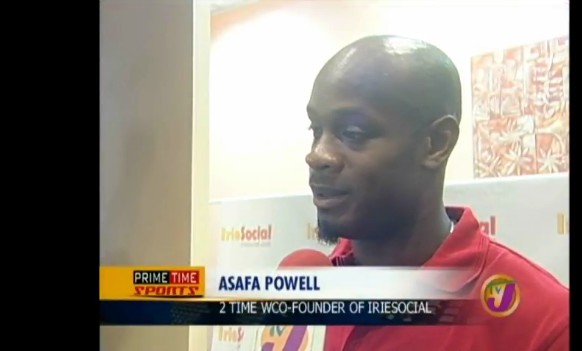
(Taken from: http://moneymax101.com/wp-content/uploads/IrieSocial1Asafa_05-May.-03-21.00.jpg)

(Taken from http://itsalwayssunnyindetroit.com/wp-content/uploads/2012/08/yohan-blake-olympics.jpg)

(Taken from http://anniepaulose.files.wordpress.com/2012/08/screen-shot-2012-08-08-at-8-52-15-am.png)
So who says you can't make something you do into a brand and maybe even make some money from it? Dare to dream and become an entrepreneur!
Wednesday, January 23, 2013
It's FAR from Over!

Subscribe to:
Posts (Atom)